
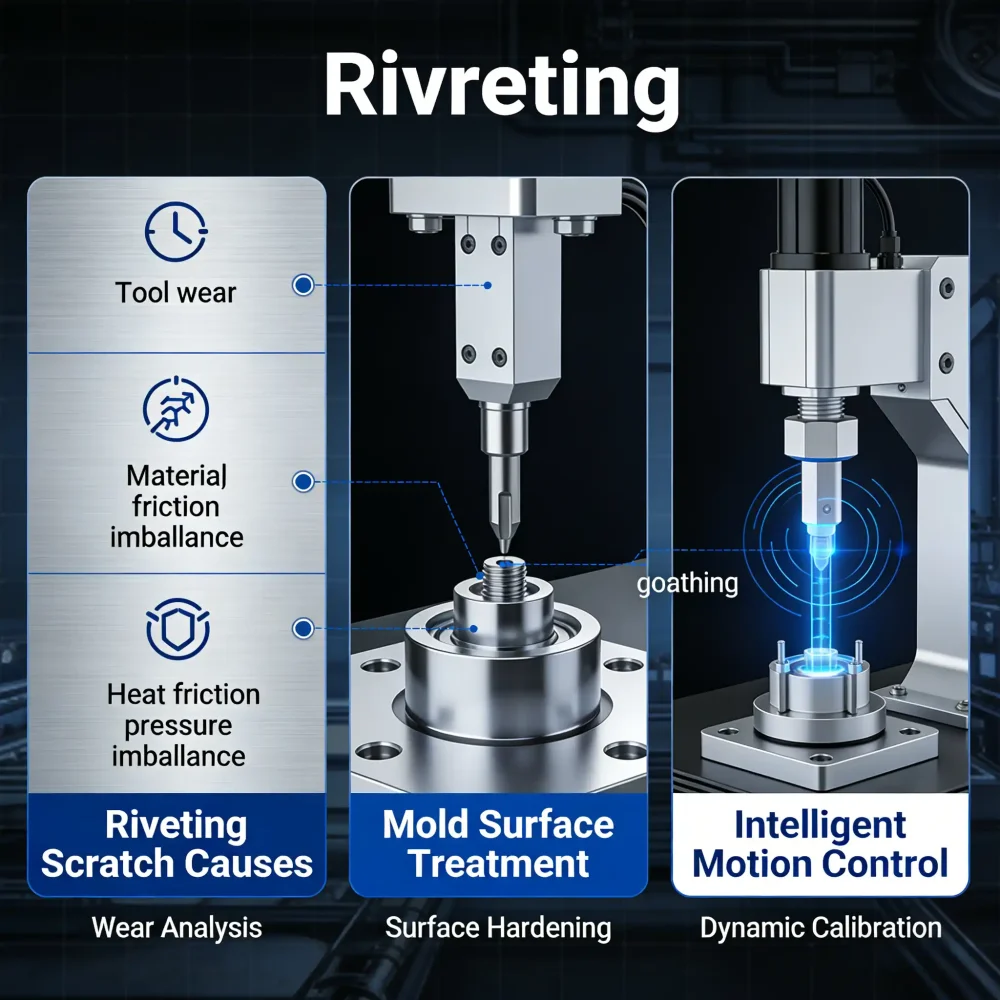
Understanding riveting scratch causes is essential for high-end manufacturing. In industries with extremely high demands on appearance, such as consumer electronics, high-end home appliances, or automotive trim parts, surface scratches on rivets are unacceptable. This not only affects aesthetics but also serves as a potential initiation point for stress corrosion or fatigue cracks. A comprehensive solution to scratches requires a complete defense system, encompassing mold engineering, motion control, and workshop cleanliness management. This article provides a thorough analysis of riveting scratch causes.
1. In-depth Analysis of Scratch Causes
A proper analysis of riveting scratch causes begins with understanding the physics. Scratches are essentially caused by the workpiece surface material being “plowed” by microscopic protrusions on the mold surface, or by adhesive wear (galling) occurring between the two under high pressure. This mechanism is central to any analysis of riveting scratch causes. Causes include:
Poor mold surface: High roughness, micro-chipping, wear pits, or attached particles on the punch working surface are the most direct causes. In any analysis of riveting scratch causes, mold condition is the first place to look.
Harmful relative sliding: If the workpiece is not completely fixed during orbital riveting, or if the riveting parameters are inappropriate, instantaneous sliding friction can occur, scratching the surface.
Process impact and overload: Excessive initial contact speed or force can lead to a “hard impact” between the mold and the workpiece, and the instantaneous high pressure can cause micro-welding of the material followed by tearing. These three categories form the foundation of a complete analysis of riveting scratch causes.
2. First Line of Defense: Exquisite Mold Surface Treatment
Mirror-grade polishing: Precision polishing of the mold punch working area to a mirror finish. This step alone eliminates many riveting scratch causes.
Anti-friction coating: For materials prone to scratches or galling, such as aluminum, copper, or stainless steel, it is recommended to use surface coatings on the mold surface, such as PVD, TD, zirconia, or silicon nitride, which can significantly improve surface hardness and smoothness, and reduce the coefficient of friction. Choosing the right coating is critical in any analysis of riveting scratch causes.
Mold lifecycle management: Establish standard procedures for mold use, cleaning, inspection, and scrapping to prevent the use of defective molds. Proactive mold management prevents most riveting scratch causes from ever occurring.
3. Second Line of Defense: Intelligent Motion Control Riveting Machine with Optimized Parameters
“Soft landing” control: Set an independent, very low “contact speed phase” in the control program to ensure the punch contacts the workpiece at the optimal speed. Soft landing directly addresses one of the main riveting scratch causes—hard impact.
Smooth force loading: Program the force to increase smoothly from zero, rather than applying it in a step-wise manner.
Riveting motion trajectory control: For special materials, match the optimal riveting motion parameters to minimize frictional heat and sliding. Together, these motion controls eliminate the dynamic riveting scratch causes that coatings alone cannot fix.
Let me add a bit more here. Without soft landing, the punch slams into the workpiece. That instantaneous impact creates micro-welding and tearing, even if your mold is perfectly polished. So when you do a full analysis of riveting scratch causes, you’ll find that motion parameters are just as important as mold finish. Many shops overlook this and keep scratching parts even after buying expensive coatings. Don’t be that shop.
4. Systematic Workshop Control
Environment and Cleaning: Maintain a clean working environment to prevent foreign objects from contaminating parts or tools. Dust and debris are often overlooked riveting scratch causes.
First Article Inspection Procedure: After each shift or tool change, perform a rigorous inspection of the first piece using high-intensity LED lights or a magnifying glass. Catching scratches early confirms that your analysis of riveting scratch causes was correct.
Conclusion
Eliminating scratches is a systematic process that embodies the pursuit of excellence in the manufacturing process. Shuntai Technology not only provides the ST-MSF series servo track riveting machines with “soft landing” control functions, but also offers professional mold polishing and coating services, as well as complete process debugging support, ensuring that your products have a flawless surface. A thorough analysis of riveting scratch causes combined with these solutions delivers scratch-free production.