
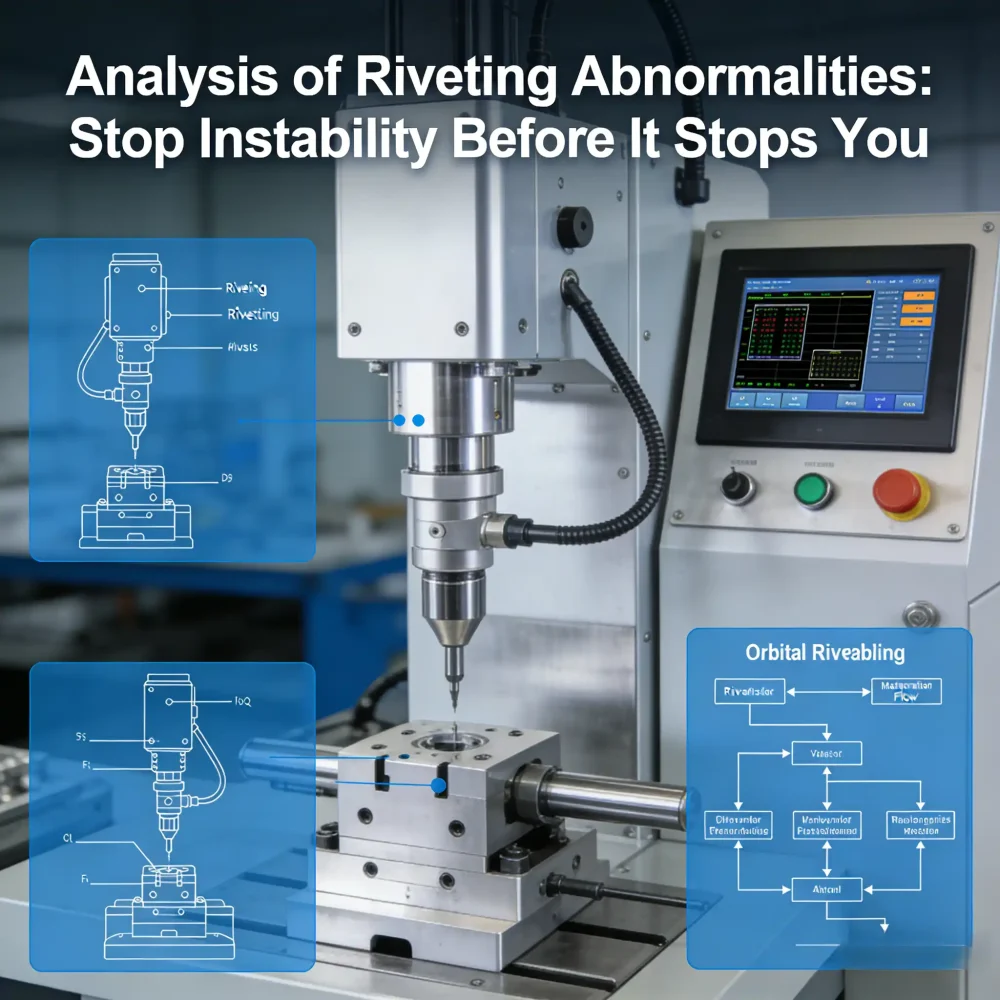
Why You Need a Solid Analysis of Riveting Abnormalities
The most annoying problem in production is “instability.” It causes quality swings, unpredictable defects, and messes up your whole quality control and production planning. An unstable orbital riveting machine is like a time bomb on your line. To get long-term stable riveting, you need a systematic approach—like a detective hunting down every source of variation. That’s where a proper analysis of riveting abnormalities comes in.
Without a good analysis of riveting abnormalities, you’ll keep firefighting instead of preventing. So let’s break it down.
1. Accurate Diagnosis of Causes (Four Symptom Clues)
Here’s how to start your analysis of riveting abnormalities based on what you see:
Random dimensional variations: Check key component dimensions, inspect molds, and look for fluctuations in power source or fixtures. Don’t skip the little stuff.
Inconsistent appearance: Check if mold and parts are aligned right. Also check spindle servo runout, rivet hardness consistency, and loose fixture servos. This part of the analysis of riveting abnormalities often gets ignored.
Abnormal noise & vibration: Look for worn mechanical parts like spindle bearings, gears, belts. Also check for dynamic imbalance or loose machine foundation. Noise is a big clue.
Intermittent alarms or machine crashes: Could be loose electrical connections, circuit faults, intermittent sensor failures, or control software glitches. These are tricky—so your analysis of riveting abnormalities must include electrical checks.
So yeah, start with these four symptom categories.
2. Layered Troubleshooting: Four Defense Lines for Stability
A complete analysis of riveting abnormalities uses four defense lines. Here they are:
Defense 1 – Mechanical Foundation: Check frame rigidity (no visible vibration at full load), spindle bearing clearance, guide rail wear and lube, and machine leveling. This is the physical base for all precision. Skip it and your analysis of riveting abnormalities is useless.
Defense 2 – Power & Drive System: Check air compressor pressure stability, FRL unit condition (filter, regulator, lubricator), and cylinder leaks. For hydraulics, monitor oil temp (best at 40-55°C), valve response, and internal leaks. For electrics, check motor/encoder connections, drive parameters, and communication links. This step in the analysis of riveting abnormalities catches many hidden issues.
Defense 3 – Process & Input Consistency: Set up incoming inspection standards for key materials. Monitor batch consistency of hardness and thickness. Create mold history records and use preventive replacement based on cycle counts or process signals. Without this, your analysis of riveting abnormalities will keep pointing to the same root causes.
Defense 4 – Environment & Process Control: Minimize big swings in shop temperature and humidity. Use data from intelligent servo riveting machines (like ST-MSF series) to monitor long-term trends in peak force, cycle time, etc. Do preventive maintenance (PM) daily, weekly, monthly, yearly. And run process capability studies (Cpk) after install or major overhaul. Only machines with Cpk > 1.67 should run critical jobs. This final layer makes your analysis of riveting abnormalities proactive instead of reactive.
Conclusion
Stable riveting ain’t accidental. It comes from robust mechanical structures, stable power, smart control, consistent inputs, and rigorous maintenance. Shuntai Technology gives you not just highly stable machines, but also the methods and support to build systematic stability. So start your analysis of riveting abnormalities today—your production line will thank you.
Need a Second Pair of Eyes on Your Riveting Line?
Still fighting random defects and mysterious alarms? You don’t have to figure it out alone. Our team at ShunTai Technology eats, sleeps, and breathes riveting abnormalities. We’ve seen it all—worn spindles, flaky sensors, weird force curves, you name it.
So here’s what we can do for you. Send us your process data or a few bad parts. We’ll run a fresh analysis of riveting abnormalities and give you a clear fix plan. No endless meetings. Just engineers who know how to stabilize your line. Plus, we offer sample trials and on-site troubleshooting. Give us a shout—let’s kill those abnormalities together.