
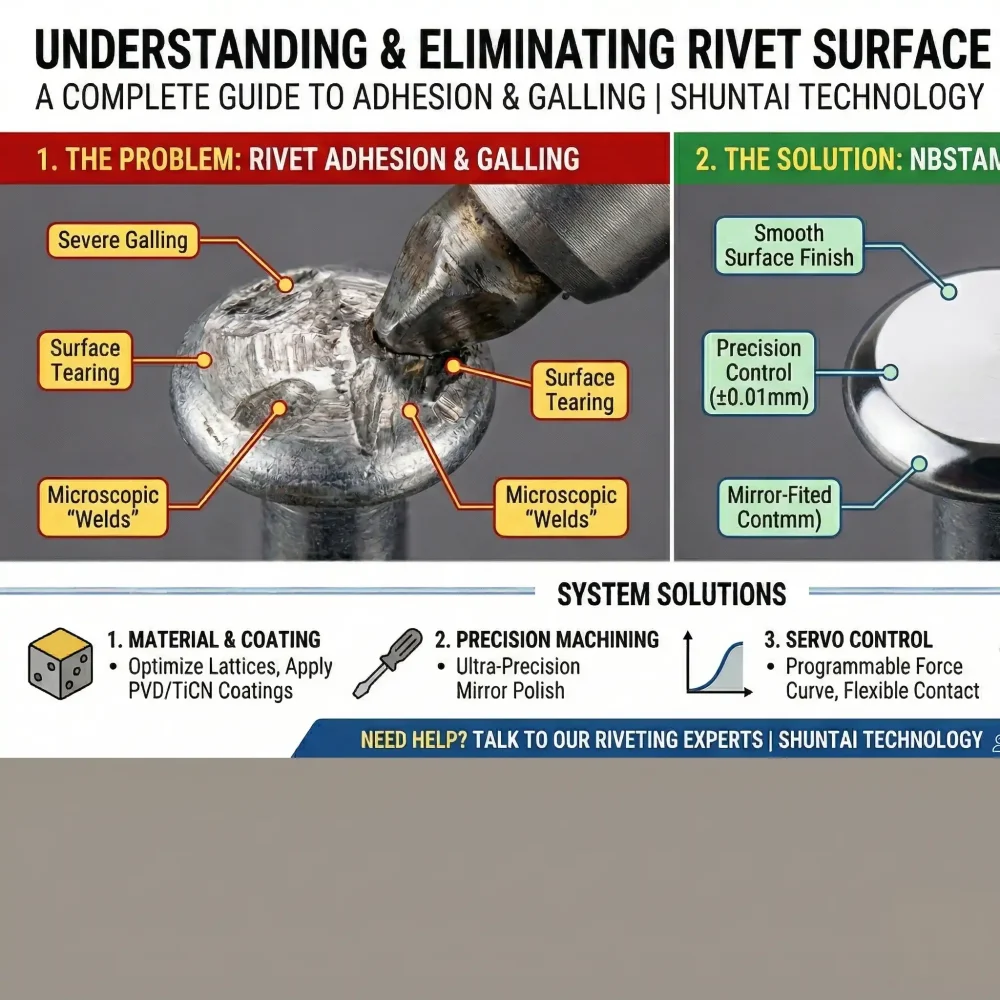
For products with high aesthetic requirements, rivet adhesion (or galling) is a fatal defect. It also speeds up tool wear like crazy. To fix these rivet surface defects, you need a systematic approach—materials science, surface engineering, and tribology all matter. This article breaks down why adhesion happens and how to stop it.
1. Microscopic Mechanism of Adhesion Formation
Under high pressure and local heat during riveting, the oxide film on contact points ruptures. Intense plastic deformation and friction make the two surfaces diffuse into each other, forming microscopic “welds.” When the mold and workpiece move relative, those welds shear and tear material off, which sticks to the mold. That’s how rivet surface defects start at the microscopic level. Once you understand this, prevention gets easier.
2. Four Key Factors That Cause Adhesion
Most rivet surface defects come from one of these four things:
Wrong material match: If mold and workpiece have similar or mutually soluble hardness, diffusion and adhesion happen fast.
Poor surface quality: Low finish, tiny defects, or soft mold surface give the workpiece “gripping points” to tear material. This is a big source of rivet surface defects.
Lubrication failure: No lube means hard friction and high heat. Temperature spikes make things worse.
Bad parameters: Too much force or speed creates frictional heat, softening the material and making adhesion worse. You’ll see more rivet surface defects when running too aggressive.
So yeah, check these four before blaming the tool.
3. Systematic Solutions to Eliminate Rivet Surface Defects
Here’s what actually works to prevent rivet surface defects:
Hardness difference rule: Make sure mold hardness is way higher than the workpiece material. Don’t skip this.
Reduce inter-solubility: Pick mold materials or coatings with different crystal lattice structures than the workpiece. This cuts down atomic diffusion.
Ultra-precision machining: Polish the mold working surface to a mirror finish. Less microscopic contact points means fewer rivet surface defects.
Anti-friction coatings: Use PVD, titanium nitride (TiN), or titanium carbonitride (TiCN). These boost hardness and lower friction. They’re a game changer for fighting rivet surface defects.
Gentle force curve: Use programmable control on servo riveting machines to get flexible contact. Don’t just slam the tool.
Optimize riveting motion: Adjust orbital riveting parameters to find the sweet spot for your material.
Use proper lubricant: When the process allows, apply extreme pressure lubricants. It helps a lot.
4. ShunTai Technology’s Support
ShunTai Technology doesn’t just sell servo orbital riveting machines with precise, gentle control. We also provide one-stop solutions based on your materials—mold manufacturing, mirror polishing, and coating services. If you’re struggling with rivet surface defects, we can help you fix them at the source.
Conclusion
Overcoming rivet adhesion needs a full strategy. With scientific material matching, careful surface treatment, gentle process control, and good tool maintenance, you can get flawless riveting. That means better product quality and longer tool life. Don’t let rivet surface defects ruin your production line—start with the solutions above.
Looking for help with your riveting process? If you’re running into technical issues or stubborn surface defects—don’t just guess and hope. Our team at ShunTai Technology specializes in riveting defects day in and day out. We’ve seen it all: adhesion, galling, cracking, you name it. We don’t just sell machines; we solve problems.
So what can we do for you? We offer real solutions, including custom process optimization and sample trial services. You send us your parts and materials; we’ll run tests and show you what works. No hard sell—just engineering know-how. Give us a call or drop an email. We’d honestly love to sit down (virtually or in person) and talk through your riveting challenges. Let’s fix those defects together.