
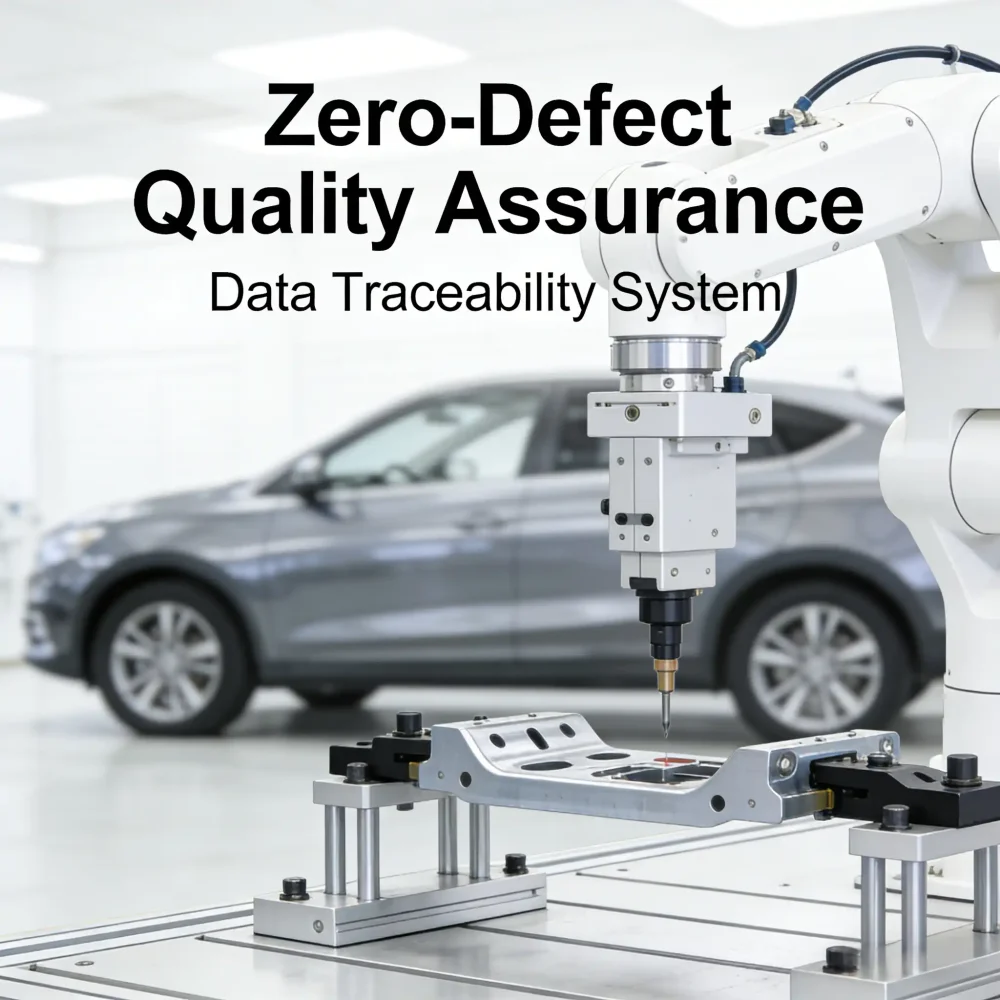
In the manufacturing of automotive safety components, there is no room for error. In automotive manufacturing, safety is the absolute bottom line. For critical safety components such as brake calipers, steering system components, and seatbelt retractors, riveting quality must achieve “zero defects.” Methods relying on operator skill and sampling inspection can no longer meet these stringent requirements. Intelligent servo-driven riveting machines are replacing “result sampling” with “process assurance,” building a solid foundation for automotive safety. This is what modern manufacturing of automotive safety components demands.

1. Unique Challenges in Riveting Automotive Safety Components
Let me walk you through the three big challenges in manufacturing of automotive safety components.
Consistency Requirements: Every single one of millions of rivets must have the same strength and reliability; no batch-to-batch variations are allowed. In the manufacturing of automotive safety components, a single weak rivet can lead to a recall.
Materials and Structure: Involves combinations of various materials such as high-strength steel, aluminum, and cast iron, often used in multi-layered precision components, requiring strict control over deformation.
Comprehensive Traceability: Must comply with standards such as IATF 16949, requiring full process data traceability from raw materials to finished products. Any quality issue must be quickly and accurately traced to its root cause. Traceability is not optional in manufacturing of automotive safety components—it’s mandatory.
2. Core Capabilities of Servo Riveting Machines
Servo technology addresses all three challenges in manufacturing of automotive safety components. Here’s how.
Exceptional Repeatability and Stability: Achieves a repeatability accuracy of ±0.01mm through full closed-loop servo control and precision ball screws. This ensures high consistency in clamping force at each joint, physically eliminating the possibility of random variations in connection strength. For manufacturing of automotive safety components, this level of repeatability is a game changer.
Intelligent Force-Position Control Mode: Applies the optimal strategy based on part characteristics. For example, constant force control is used for brake pad riveting to prevent crushing thin steel plates; while constant position control ensures precise assembly height for caliper guide pins. The system monitors in real time and stops and alarms if any abnormality occurs, preventing defects. Adaptive control is essential in manufacturing of automotive safety components.
Digital Recording and Traceability: Key parameters of each rivet—force-displacement curve, peak force, cycle time—are automatically recorded and associated with the part serial number or production batch. This “digital fingerprint,” uploaded to the MES system, enables full traceability from individual rivets to the vehicle VIN code, perfectly meeting the needs of quality audits and root cause analysis (RCA). You can’t have traceability without digital recording in manufacturing of automotive safety components.
Adaptive Compensation and Error Prevention: The system can monitor and automatically compensate for small parameter drifts caused by tool wear. Its learning function can also quickly adapt to new material batches, ensuring the process window always remains optimal. This adaptive capability reduces scrap and rework in manufacturing of automotive safety components.
3. Building a Systematic Quality Fortress
By integrating the servo-driven orbital riveting machine with systems such as machine vision (for pre-riveting alignment inspection) and online measurement (for post-riveting dimensional inspection), a closed-loop intelligent riveting unit can be constructed. This not only enables 100% online quality control but also drives continuous process optimization through data flow. A closed-loop system is the gold standard for manufacturing of automotive safety components.
Let me add one more point. In traditional manufacturing of automotive safety components, you might inspect one part every hundred or every thousand. That’s sampling. With servo riveting and vision integration, you inspect every single joint on every single part. That’s 100% coverage. The difference between sampling and 100% inspection in manufacturing of automotive safety components is huge — it’s the difference between “probably safe” and “definitely safe.”
Conclusion
For automotive safety components, quality is built into the manufacturing process, not inspected into the product. Investing in ShunTai Technology’s ST-MSF series intelligent servo-driven orbital riveting machine is not just about purchasing a high-precision piece of equipment; it’s about adopting a reliable quality assurance system centered on data and prevention—a solemn commitment to product safety and brand reputation. When you improve manufacturing of automotive safety components with servo riveting, you protect lives and your brand.