
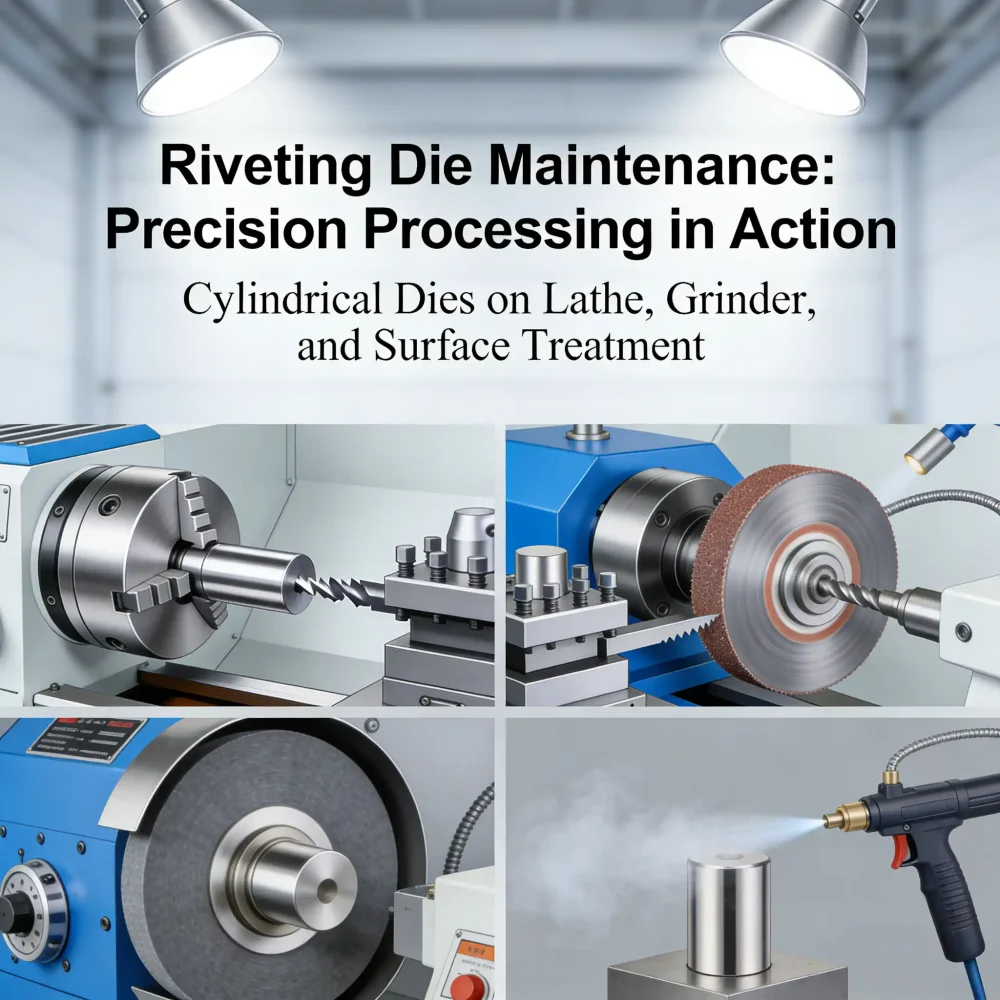
Proper riveting die maintenance begins with understanding that dies are the “teeth” of the riveting machine, directly determining riveting quality and production costs. Frequent malfunctions and unplanned replacements are major causes of downtime and increased costs. Establishing scientific maintenance and replacement standards for dies extends their lifespan, reduces costs, and improves efficiency. This article focuses on riveting die maintenance best practices.
As a core component of the riveting process, riveting dies directly impact product riveting quality, operational efficiency, and the stability of process control. Ultimately, they determine whether a product meets its specified requirements; therefore, the maintenance of riveting dies is of paramount importance.
The maintenance and upkeep of riveting dies adhere to three fundamental principles: quantitative assessment of die service life, periodic inspection, and preventive replacement based on expert judgment. Only by strictly observing these three principles can the reliability of the riveting quality be effectively guaranteed. The riveting process serves as a fastening and anti-loosening method characterized by high reliability, exceptional structural integrity, and resistance to detachment. Consequently, it is frequently employed in environments subject to high levels of vibration—a context that imposes extremely stringent demands on quality stability and, by extension, places even higher requirements on the maintenance and upkeep of the riveting dies themselves.
1. Key Daily Maintenance Techniques
Cleaning is crucial: After each die change or at the end of production, thoroughly wipe the spherical end face of the punch and the forming surface of the clamp with a lint-free cloth and a special cleaning agent to remove fine metal debris, preventing scratches and corrosion.
Proper lubrication: Apply anti-rust lubricating grease to the non-working surfaces of the die.
Standardized installation: When replacing dies, always use a special centering sleeve or installation fixture; never strike directly with a hammer.
Storage management: Spare dies should be cleaned and stored in a dry, dedicated toolbox, with each die stored separately to prevent collision and dust contamination.
Regular inspection: Check the die clamping ring or locking mechanism weekly for looseness. Slight looseness can cause small displacements during high-speed operation, accelerating wear. Consistent riveting die maintenance includes weekly checks.
Lifecycle management: Create a file for each set of critical dies, recording relevant information. Data is the foundation of predictive management.
Preventing overload: Set reasonable force limits through machine parameter settings. All these steps are part of effective riveting die maintenance.
2. Early Warning Signs of Die Failure
Early warning mechanism: Dies should be replaced promptly when their performance degrades to a quality threshold, rather than waiting until the die is damaged.
Appearance changes: Punch wear, material peeling, cracks, or severe material adhesion.
Quality fluctuations: Unstable dimensions, cracking, or abnormal surface scratches.
Data anomalies: Continuous increase in peak force at the process height. Recognizing these signs is a critical element of riveting die maintenance.
3. Scientific Replacement Standards
Preventive replacement: For large-volume stable production, conduct statistical analysis to determine the lifespan of specific dies, set a preventive replacement threshold, and replace the die when the threshold is reached.
Dimensional accuracy replacement: Regularly measure the dimensions of critical dies. Replace the die when wear causes dimensional changes that exceed tolerance requirements.
Cpk-based replacement: Regularly re-evaluate the Cpk of critical rivet dimensions. If the Cpk shows a continuous downward trend and approaches the warning limit, and other process factors have been ruled out, the mold condition should be suspected and inspected first. Data-driven replacement completes the riveting die maintenance cycle.
Conclusion
Shifting mold management from a reactive “replace after damage” model to a proactive model based on preventive maintenance and quantitative data-driven decision-making is crucial for controlling unit costs and ensuring long-term quality stability. Shuntai Technology not only provides high-quality original molds and PVD coating services but also offers professional mold management consulting. Mastering riveting die maintenance delivers lasting savings.