
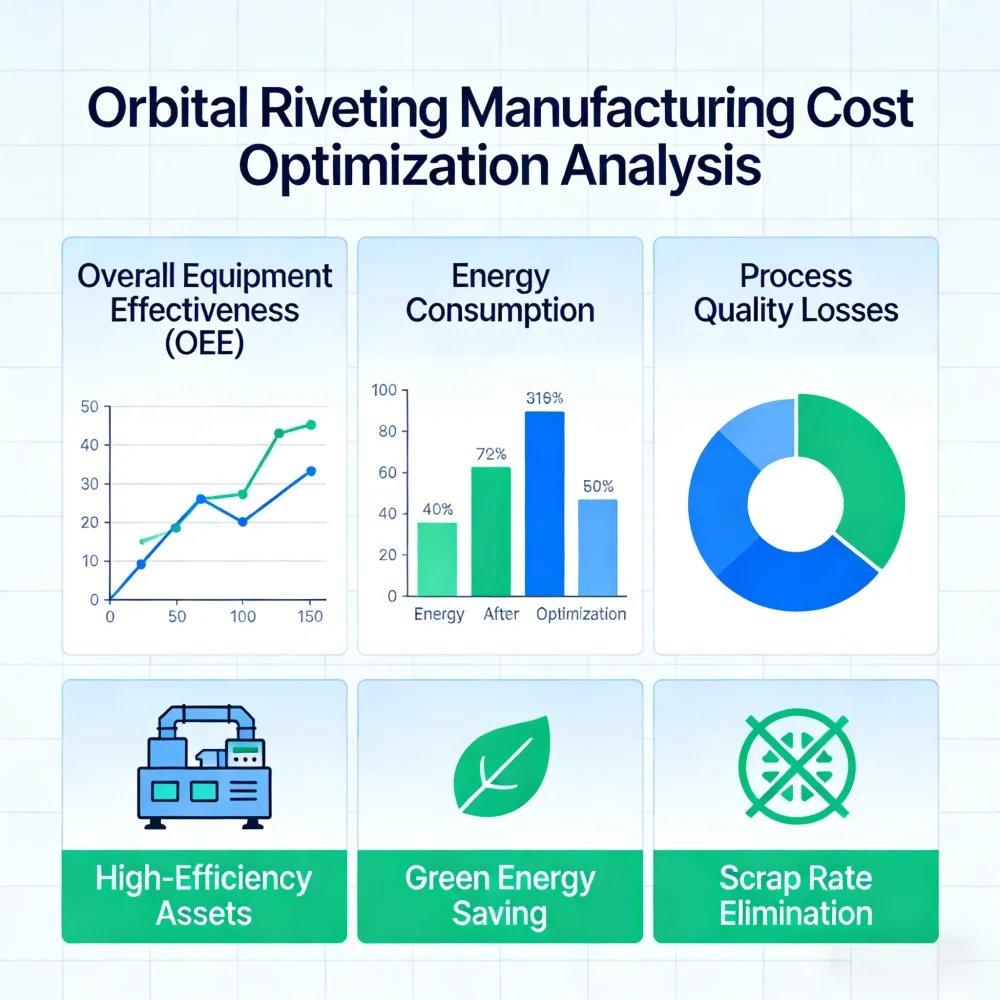
To effectively control total riveting costs, you must look beyond the purchase price. In a highly competitive market, manufacturing costs directly impact profitability. Orbital riveting, as a common processing technology, has enormous potential for cost optimization. However, achieving the lowest Total Cost of Ownership (TCO) requires abandoning the old mindset of focusing solely on machine purchase price and instead managing three key factors: Overall Equipment Effectiveness (OEE), energy consumption, and process quality losses.
1. Key A: Invest in “High-Efficiency Assets,” Not “Low-Cost Equipment”
Equipment costs are amortized over the entire lifecycle and allocated to each qualified part; OEE (output per unit of time) is a critical indicator.
Purchase Value: Simple machines lead to slow speeds, frequent downtime, and long debugging times, resulting in high amortized costs.
Optimization Strategy: Choose high-OEE servo orbital riveting machines. Their value lies in: high cycle rates and stability to increase effective output; digital quick mold change to reduce downtime; and high reliability to minimize downtime due to failures. This approach directly helps control total riveting costs.
2. Key B: Target “Energy Black Holes” for Green Energy Savings
Under the “dual carbon” goals, energy is a significant hard cost. Traditional riveting equipment wastes a surprising amount of energy.
Energy Black Hole Analysis: Pneumatic systems rely on compressors, and overall energy utilization is usually below 15%; hydraulic systems have continuous overflow and throttling losses, converting a large amount of electrical energy into useless heat.
Cost Strategy: Switch to all-electric drive for on-demand power supply and eliminate conversion losses. Servo riveting machines can save tens of thousands of yuan in electricity costs annually compared to pneumatic or hydraulic systems, with even greater savings across multiple production lines. Lower energy use is another way to control total riveting costs.
3. Key C: Eliminate “Scrap Rate”
Scrap is the biggest cost in riveting, consuming not only rivets but also all the accumulated value of previous processes on that workpiece. Scrap cost composition: Scrap cost = (Material cost + Previous process value + Riveting cost) * Number of scrapped parts.
Optimization Strategy: Shift from “post-process inspection and scrapping” to “real-time process prevention.”
Process Stability: Use closed-loop control servo equipment to ensure absolute parameter consistency from the source, eliminating random defects. Monitoring and Error Prevention: Utilizing force-displacement curves and machine vision alignment technologies to detect and stop the process at the first sign of a defect.
Root Cause Prevention: Using SPC analysis to monitor process data trends and make adjustments before process drift leads to batch rejection. Reducing scrap is essential to control total riveting costs.
Conclusion
Reducing the total cost of the riveting process is a profound management transformation. It requires companies to shift their focus from “unit price” to “value,” from “reactive maintenance” to “proactive prevention,” and from “experience-based management” to “data-driven decision-making.” ShunTai Technology’s integrated solutions are designed around these three cost dimensions, aiming to help customers build efficient, energy-saving, high-quality, and sustainable production systems. By following this guide, you can fully control total riveting costs.
Riveting Cost Control Strategies
- Riveting costs are multifaceted, comprising factors such as energy consumption, scrap costs, riveting efficiency, labor costs, costs associated with managing high-risk products, as well as direct and indirect energy losses; collectively, these elements constitute the total cost of riveting.
- To achieve the most economical riveting costs, one must address these various aspects; among them, scrap costs and the costs of managing high-risk products represent the most significant sources of loss. Since products carrying potential risks can easily lead to substantial financial liabilities, control efforts must be primarily focused on these two specific areas.
- Implementing automated risk identification and management—thereby enabling the feasibility of cost-reduction strategies—is a long-term undertaking. Achieving optimal control over riveting costs requires not only advanced manufacturing equipment but also sophisticated process control methodologies.