
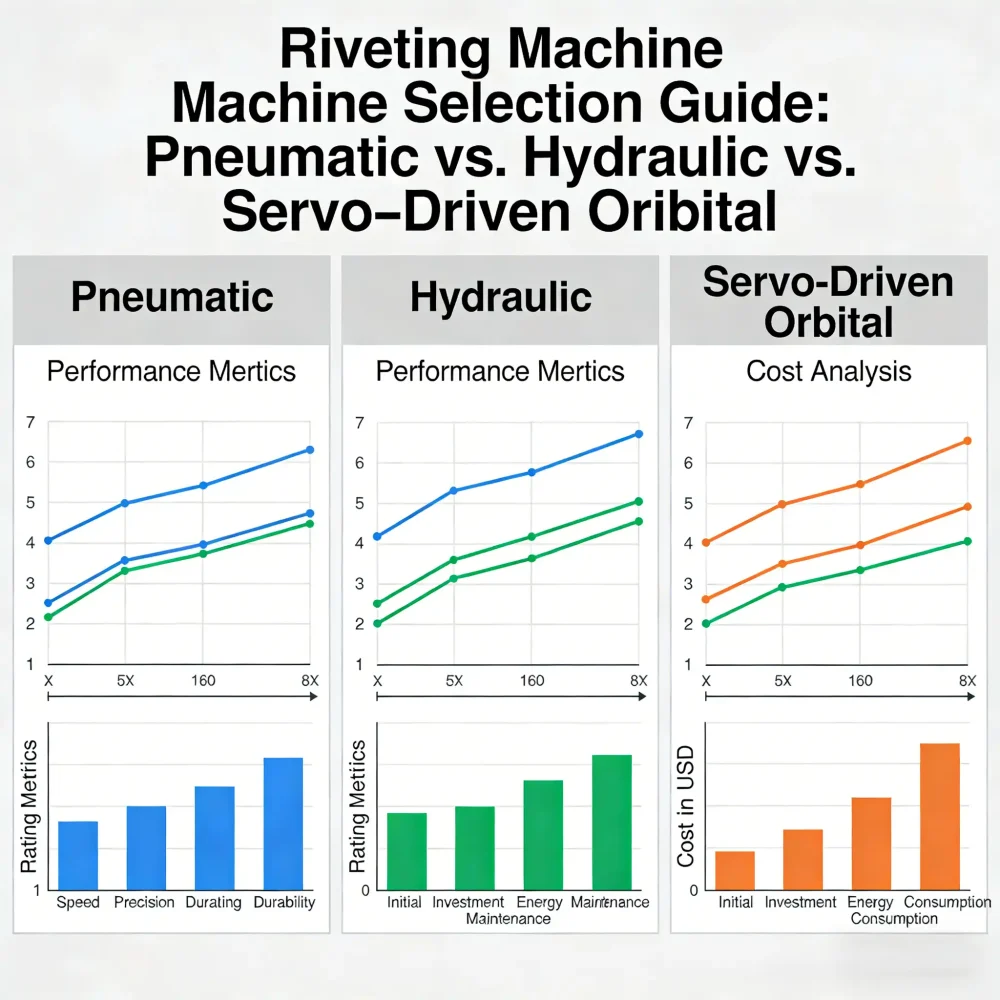
Why You Need to Know How to Choose a Riveting Machine
Picking between pneumatic, hydraulic, and servo-driven orbital riveting machines? It ain’t just about the price tag. It’s a strategic call that affects production efficiency, product quality, and total cost of ownership for years. Pick wrong and you’ll bleed money. So let’s talk about how to choose a riveting machine the right way.
Before you sign that PO, here’s a few things you need to know.
1. Core Performance Comparison (Three Types)
Let me lay out a table. Because how to choose a riveting machine gets a lot easier when you see them side by side:
| Dimension | Pneumatic | Hydraulic | Servo |
|---|---|---|---|
| Control accuracy & consistency | Low. Pressure fluctuates, humidity affects it. No real repeatability. | Medium. Oil temperature messes with stability. Position is ok but force control lags. | Very high. Fully digital closed-loop. Real-time programming of position, speed, force. High repeatability. |
| Efficiency & flexibility | Lower. Fast under no-load but impact force is rough. Changeover means adjusting air valves—slow. | Medium. Slow response, limited speed range. Changeover is a pain. | High. High-speed no-load, stepless speed adjustment. Digital recall, one-button changeover. Boosts OEE. |
| Energy consumption & operating costs | High. Compressor runs continuously. Pipe leaks waste energy. Efficiency around 10-25%. | Medium. Pump runs all the time, overflow and throttling losses. Oil temp control eats more power. | Extremely low. On-demand power supply. Near-zero consumption when idle. Efficiency up to 80%. |
| Intelligent systems & data integration | Almost none. No data interface, no monitoring. | Difficult. No native data interface. High conversion cost. | Native support. Standard industrial comms (OPC UA, etc). Full process data recording, predictive maintenance. Integrates with MES/IoT. |
So that’s the high-level view. Understanding how to choose a riveting machine means knowing which of these dimensions matter most for your operation.
2. Selection by Application Scenario
Here’s where how to choose a riveting machine gets practical:
Pick pneumatic if: Your budget is super tight, quality requirements are very low, you’re making non-critical parts, production pace is slow, and you don’t mind high scrap rates. That’s a small set of use cases.
Pick hydraulic if: You need very high force (over 3 tons) but accuracy isn’t critical. Or you already have a central hydraulic power unit on site. Or your process needs continuous high-pressure holding.
Pick servo if: You have high requirements for riveting quality, consistency, and reliability (automotive, aerospace, precision electronics). You run multiple materials and need fast changeover. You care about productivity, low unit cost, and energy savings. Or you need process data traceability, error-proofing, and smart factory integration.
3. Total Cost of Ownership (TCO) as Your Real Decision Factor
Here’s the part people miss when learning how to choose a riveting machine: TCO.
Pneumatic machines have low purchase price. But electricity costs are high. Maintenance costs add up. Hidden scrap costs from inconsistent quality? They hurt more than you think.
Hydraulic machines sit in the middle.
Servo machines cost more upfront. But superior energy efficiency (save 50-70% on electricity), extremely high yield rate, near-zero maintenance, and fast mold change? You’ll recover the premium in 1-3 years. After that, it’s pure profit. So yeah, how to choose a riveting machine comes down to looking past the sticker price.
Conclusion
Choosing the drive type for an orbital riveting machine is really choosing a production philosophy. In today’s competitive manufacturing environment—where high quality and sustainability matter more than ever—servo orbital riveting technology is a smart investment in your future. Now you know how to choose a riveting machine with confidence. Make the call that saves you money long-term.
Still not sure which technology fits your parts? We get it. Every application is a little different—material type, joint strength, production volume, even shop floor layout matters. Shuntai’s engineers have worked through hundreds of these comparisons. No hard sell, just honest input. If you want a second pair of eyes on your spec sheet or a quick cost estimate, drop us a line. We’ll share what we’ve learned (the hard way, so you don’t have to).