
Understanding riveting joint deformation starts with recognizing unbalanced forces. Riveting deformation is a common problem that can lead to part rejection, assembly interference, reduced dimensional accuracy, and decreased strength. The root cause lies in unbalanced forces acting on the workpiece. To control riveting joint deformation, you need a systematic approach. A systematic solution requires a collaborative approach from two dimensions: process parameter control and mold design optimization, thereby achieving precise management of “force.” This article focuses on preventing riveting joint deformation through parametric design.
1. Root Cause Analysis:
Three main causes of riveting joint deformation are often overlooked.
Bending deformation: Caused by non-perpendicular axial forces. Misalignment of the punch axis or non-parallel anvil support generates lateral force components, which act as a lever, causing the workpiece to bend. This type of riveting joint deformation is common when tooling is worn.
Local bulging or indentation: Caused by uneven radial expansion forces. When the rivet material’s flow is restricted within the hole or the anvil support is insufficient, pressure can lead to uncontrolled plastic flow in localized areas. Localized riveting joint deformation often appears as surface bumps or dents.
Thermally induced deformation: Local heat generated during high-speed or large-deformation riveting can lead to uneven thermal expansion, resulting in residual stress and deformation after cooling.
2. Process Parameter Optimization Strategies:
Smart parameter choices can dramatically reduce riveting joint deformation.
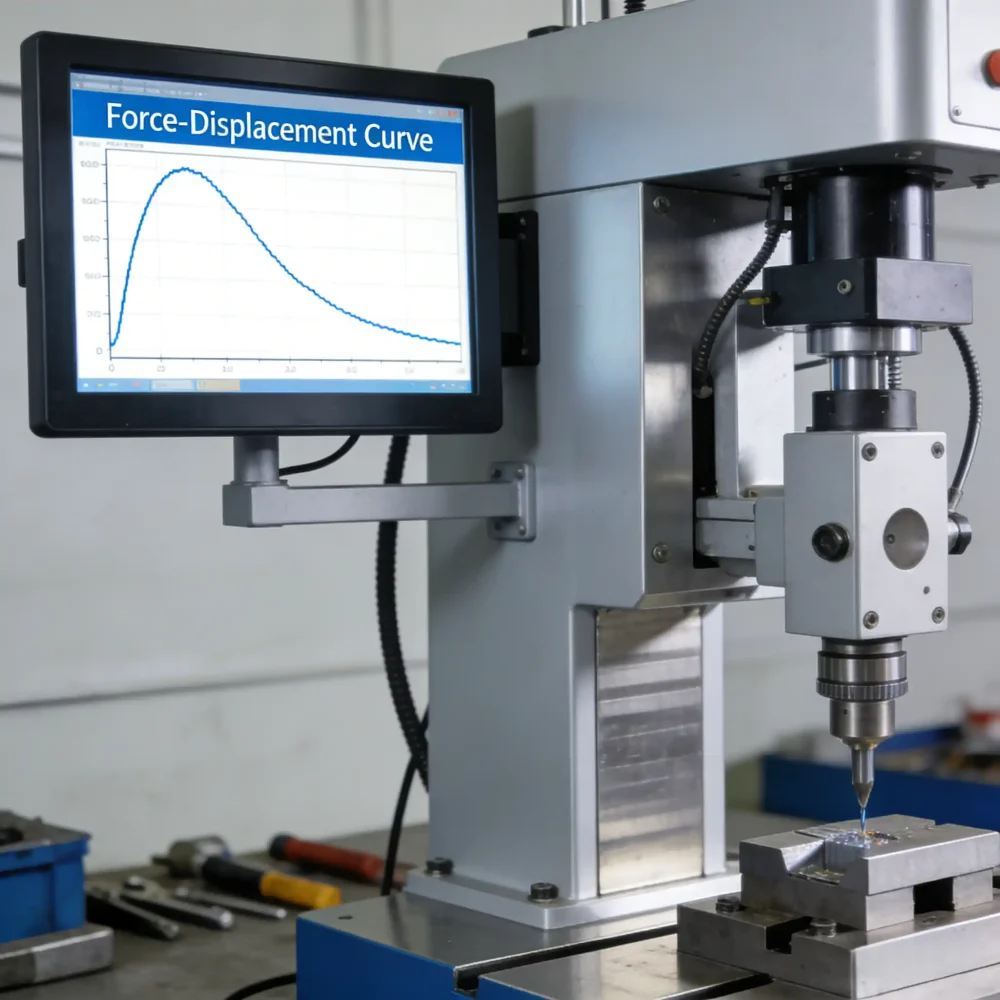
Optimizing the force-displacement curve: Using “skillful force” rather than “brute force,” intelligent curve programming for servo-controlled orbital riveting machines can significantly reduce the risk of deformation and avoid single high-impact forces. Use multi-stage or ramped force curves. For example, set a lower initial contact force, then smoothly increase to the forming force, and finally maintain it briefly. This allows the material to flow sequentially and smoothly. A well-tuned force curve is your best defense against riveting joint deformation.
Precise speed control: Reducing the punch speed at the moment of contact can significantly reduce dynamic impact. Maintaining a constant speed during the forming stage helps to ensure uniform stress distribution. Speed control directly affects riveting joint deformation, especially with thin-walled parts.
Adaptive function: The machine’s adaptive algorithm can automatically find the optimal balance between sufficient forming force and minimum part deformation during trial production.
3. Mold and Fixture Design Optimization:
Tooling design is equally critical for preventing riveting joint deformation.
Ensure absolute alignment: The concentricity error between the punch and the anvil must be minimized. Use high-precision quick-positioning devices to ensure alignment of the punch and workpiece. Misalignment is a primary driver of riveting joint deformation.
Secure part fixation: Ensure that the fixture can completely fix the workpiece and provide sufficient support force to ensure that the rivet is fully supported during the riveting process without uncertain displacement.
Scientific punch design: The shape of the punch head directly affects the direction of material flow. Optimized design for specific materials can guide the metal to efficiently fill the cavity instead of being harmfully squeezed to the sides. Punch geometry is the final piece of the riveting joint deformation puzzle.
Let me add some practical advice. Many engineers only look at one factor—either parameters or tooling. But riveting joint deformation usually comes from multiple sources. Start by checking alignment. Then verify fixture rigidity. Then tune the force curve. If you still see riveting joint deformation after those three steps, look at material batch consistency or punch wear. A methodical approach eliminates guesswork.
Conclusion
Preventing deformation is a complex process. ShunTai Technology’s ST-MSF series, with its precise programmable control, combined with professional mold design services, provides customers with a complete solution from process to tooling, ensuring the riveting quality of complex and precision parts. Don’t let riveting joint deformation ruin your yield—address it at the design and parameter stage.