
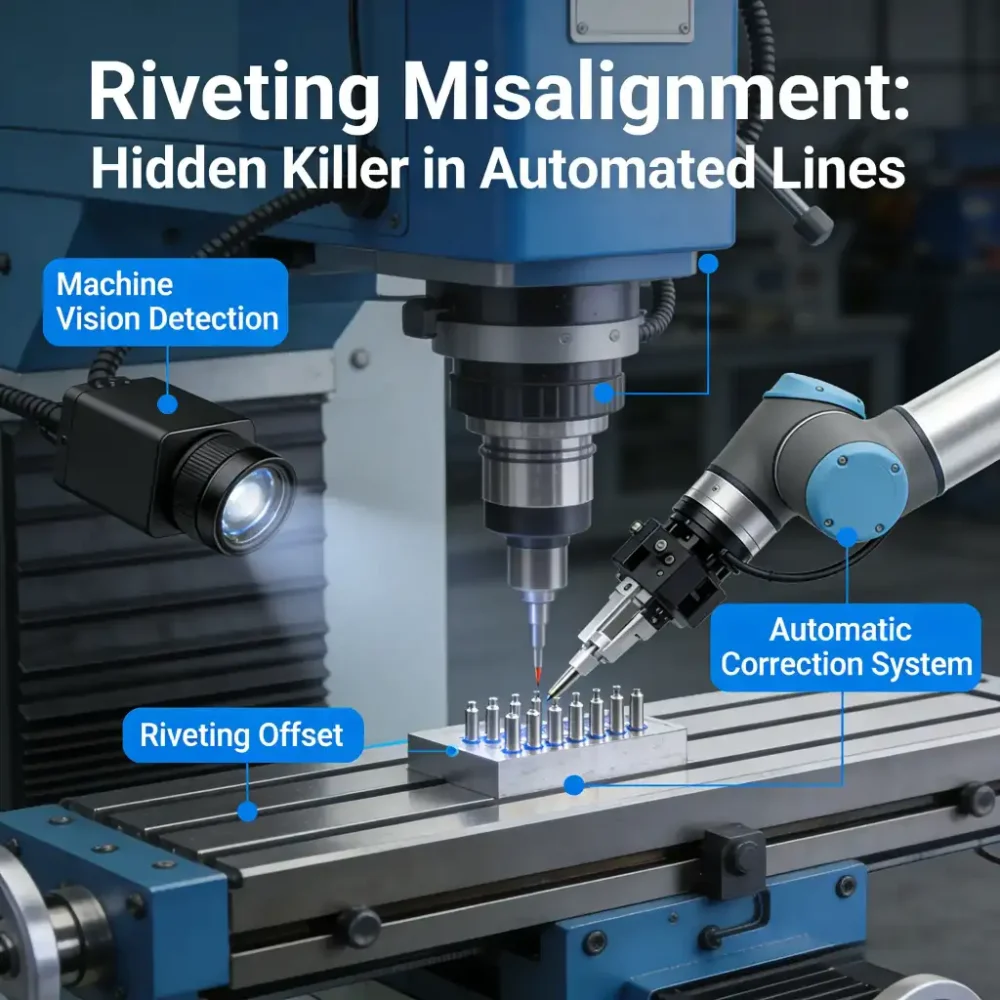
Riveting misalignment is a hidden killer on automated lines. In automated riveting, misalignment between the rivet and the workpiece hole leads to uneven stress distribution on the rivet, poor appearance, and even scrapped parts. Manual visual inspection is inefficient and unreliable. Adopting automatic detection and correction to achieve 100% quality reliability is crucial for enhancing riveting intelligence and realizing a “lights-out factory.”
1. Misalignment Error Analysis
Riveting misalignment can come from three main sources. Let me list them.
Feeding errors: Inherent vibration or wear in mechanisms such as workpiece feeders or rivet feeders can cause random deviations when rivets are delivered to the preset position. This type of riveting misalignment is often intermittent and hard to catch.
Positioning and clamping errors: Workpiece hole machining tolerances, wear of fixture locating pins, or insufficient clamping force can cause slight movement of the part, changing the actual center position of the hole. If your fixture is worn, you’ll see riveting misalignment on every cycle.
Alignment errors: Initial mechanical misalignment between the rivet spindle and the fixture, or deviations that drift over time due to structural deformation or wear. Over time, even small alignment drift adds up to serious riveting misalignment.
So yeah, three sources. You need to detect all of them.
2. Automatic Detection: Machine Vision as the “Intelligent Eye”
How do you catch riveting misalignment in real time? Machine vision. Integrating machine vision for online recognition and detection at the riveting station ensures accurate positioning and improves reliability.
Image acquisition: High-resolution industrial cameras, under precise ring light illumination, capture clear images of the rivet head and workpiece hole.
Algorithm recognition: Vision software uses edge detection analysis algorithms to accurately identify and calculate the coordinates of the rivet center and hole center.
Offset calculation: Pixel coordinates are converted into actual physical coordinates, and the X and Y offsets are determined through precise system calculations. With these steps, even a tiny riveting misalignment of 0.05mm gets caught.
3. Automatic Correction Intelligent Response Strategy
Once the system detects riveting misalignment, it needs to act fast. Here’s how:
Dynamic compensation: The calculated data is sent to the drive unit via a high-speed bus for compensation.
Automatic station rejection: For misaligned parts that cannot be corrected on-site, the vision system directly sends an NG signal to the system, triggering the rejection mechanism to automatically eject the part, preventing defective parts from flowing into downstream processes. If riveting misalignment is too severe, we reject it right there.
Adaptive adjustment: For slight and predictable misalignments, the system adaptively adjusts riveting parameters to guide material flow and compensate for the strength on the right side.
Let me add something here. Without automatic correction, you’d have to stop the line, pull the bad part, and figure out what went wrong. That takes minutes. With intelligent response, the whole cycle happens in milliseconds. That’s the difference between ignoring riveting misalignment and mastering it.
4. Automated Integration Value Proposition
Integrating the vision system with ShunTai Technology’s servo riveting machine creates a complete intelligent riveting unit. This not only enables 100% online inspection and real-time correction but also uploads all data to the MES system. This data can be used to analyze error source trends and continuously optimize the process, thereby achieving data-driven manufacturing. Every recorded riveting misalignment event becomes a learning opportunity for your production line.
Think about it. If you see a pattern of riveting misalignment from the same fixture every Tuesday, you know something is drifting. Maybe temperature, maybe wear. The data tells you.
Conclusion
Automatic detection and correction technology for riveting misalignment integrates sensing, decision-making, and execution. It is a core bridge connecting traditional automation with future intelligent manufacturing, marking a fundamental leap in the riveting process from “ensuring action execution” to “ensuring reliable quality.” Don’t let riveting misalignment ruin your yield. Upgrade to intelligent detection today.