
Delve into the Automotive EV Manufacturing Challenges
In 2025, the global new energy vehicle industry is growing like crazy. Shuntai Automation is strategically focusing on this emerging field. Let’s delve into the automotive specific needs, especially the technical requirements for connecting battery pack structural components. We’ve analyzed it deeply and developed specialized riveting equipment for new energy battery manufacturing. So when we delve into the automotive battery assembly process, the first thing you notice is how tricky composite-to-metal joints can be.
1. Why You Need to Delve into the Automotive Battery Pack Problems
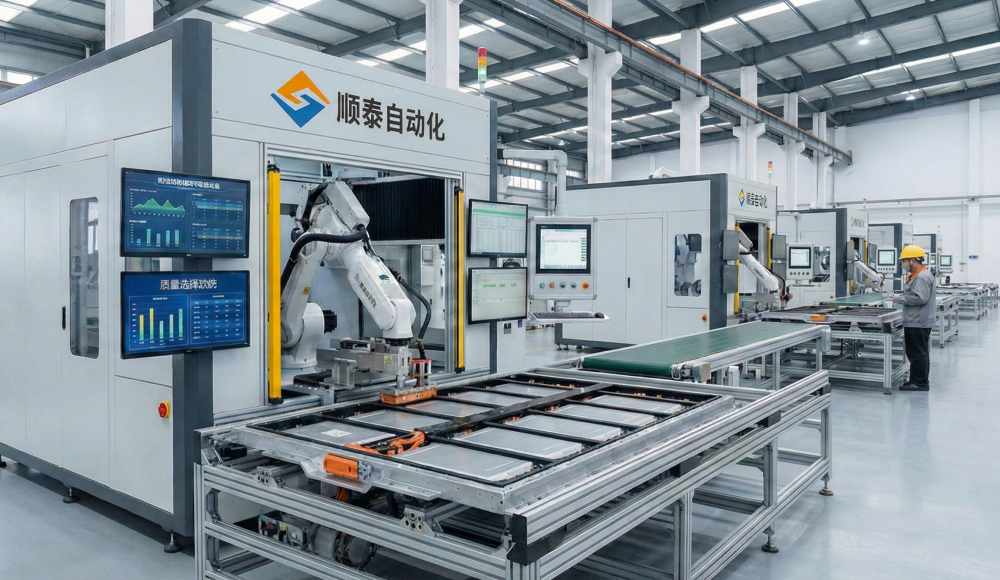
Traditional riveting just doesn’t cut it for EV batteries. You’ve got lightweight designs, safety requirements, and the nightmare of connecting composites to metals. To really delve into the automotive quality issues, you’ll see that poor riveting leads to field failures and warranty claims. That’s why our equipment solves the reliable connection problem for complex structures.
2. Modular Design and Fast Changeover
Our equipment features a modular design. You can adjust and reconfigure based on different battery models and structural characteristics. When you delve into the automotive manufacturing floor, modularity is a big deal. Swap tooling, change parameters, run a different battery pack in under an hour. That’s flexibility. This approach cuts downtime by 40% or more.
3. Process Database and Quality Traceability
We also developed a dedicated process database and quality traceability system. Every connection point’s quality is monitored and traceable. If you delve into the automotive industry’s audit requirements, you’ll know traceability is non-negotiable. Our system logs force-displacement curves, peak force, and rivet height. So when you review a customer’s quality report, you have proof of every joint. That’s peace of mind.
4. Real-World Results from EV Makers
Currently, this equipment is running in several new energy vehicle manufacturing companies. It’s improving production efficiency, ensuring connection quality, and reducing costs. Let’s delve into the automotive numbers: cycle times down 25-40%, scrap rates under 0.3%, and OEE up by 30%. One plant went from 120 battery packs per shift to over 200. The ROI payback is usually under six months.
5. Why Shuntai?
Look, there’s a lot of riveting equipment out there. But to truly delve into the automotive EV battery challenges, you need purpose-built solutions. We’ve spent years understanding thermal management, vibration resistance, and creep fatigue. Our equipment handles composite-to-metal, aluminum-to-steel, and other tough combinations. So when you evaluate the 2025 market, Shuntai should be on your shortlist.
Conclusion
To delve into the automotive EV battery manufacturing is to realize that old methods don’t work anymore. You need modular design, traceability, and real-time process control. Shuntai delivers that. Let’s delve into the automotive future together—reach out for a consultation or sample trial.
As the primary mode of daily transportation for people, automobiles must be safe and reliable—capable of operating trouble-free over decades of service. This places extremely high demands on both their design and manufacturing. Ensuring such reliability requires not only advanced materials and design concepts but also sophisticated manufacturing processes and control mechanisms; furthermore, the traceability of quality data is essential to guarantee product integrity.
In recent years, the automotive industry has faced intense competition and shortened product development cycles. Consequently, manufacturing processes are subject to increasingly rigorous standards. To ensure the reliability of production operations, it is imperative to utilize process equipment that is highly adaptable, capable of rapid reconfiguration, and responsive in real time.
To navigate an increasingly competitive market landscape—and to meet growing demands for customization and intelligent manufacturing—we have developed a novel riveting technology. This integrated solution combines rapid line changeover capabilities, intelligent manufacturing functionalities, risk early-warning systems, and data traceability features into a single, multi-functional system, thereby empowering the automotive industry’s transition toward intelligent manufacturing.