
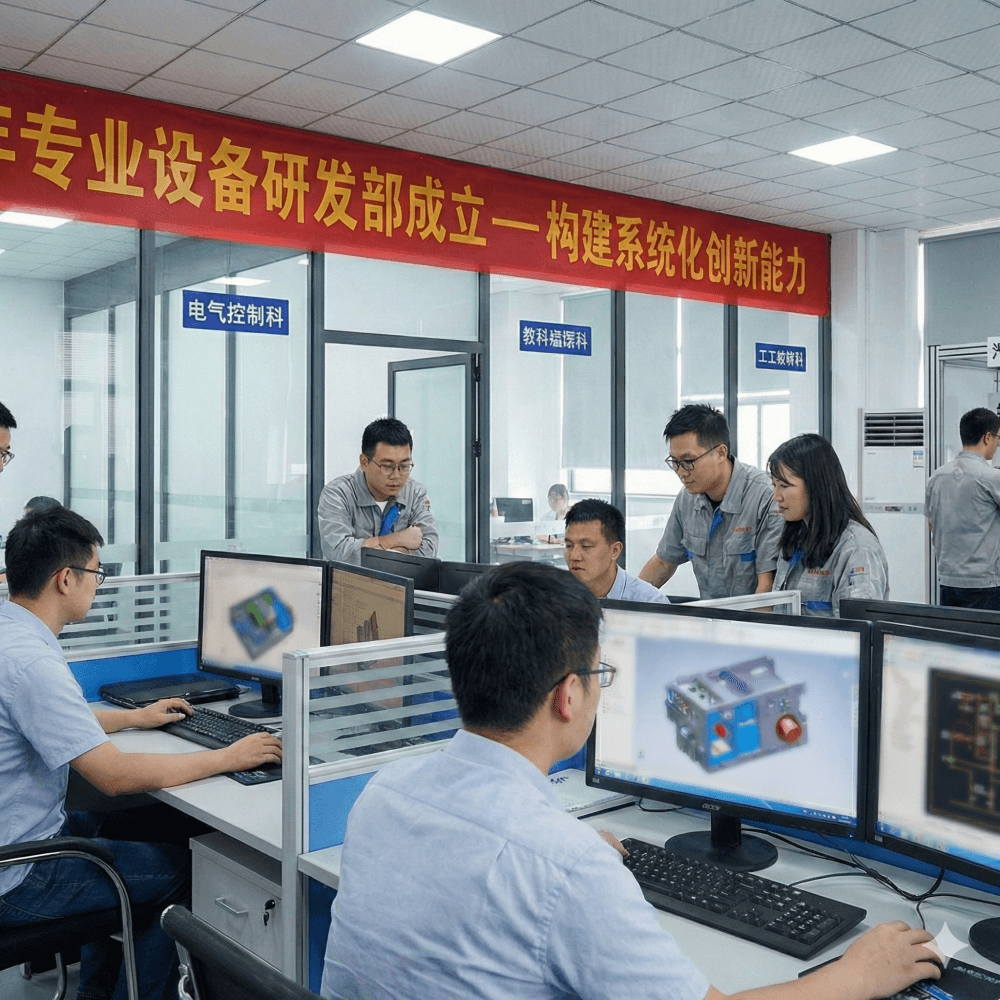
The formalization of our riveting technology research center came at a critical moment.
Following the success of the first prototype and the gradual clarification of market demand, the company officially established a professional equipment R&D department in 2017. This organizational change marked a shift in our technology development work from a project-based approach to a systematized and standardized new stage. 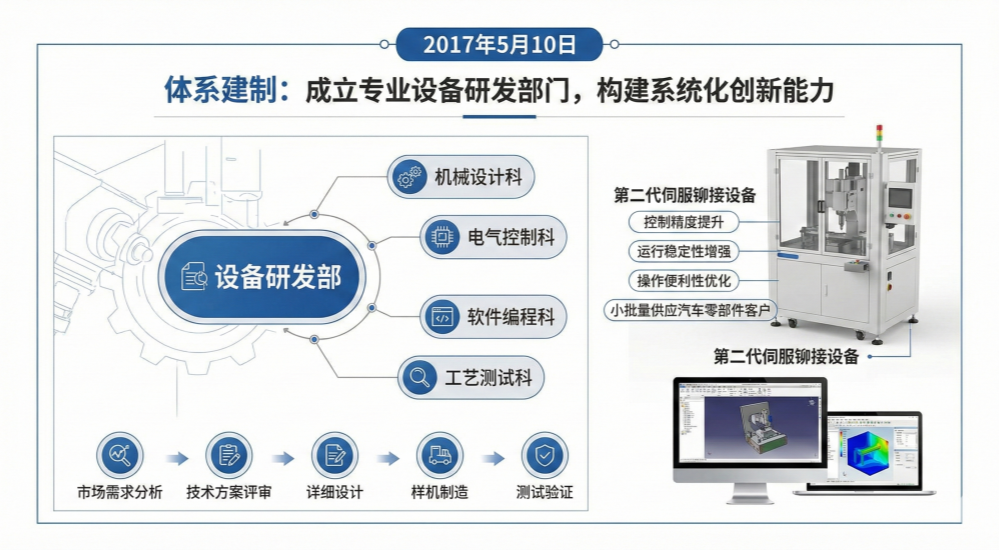
This was the foundation of what would become a full-fledged riveting technology research center.
The R&D department established specialized divisions for mechanical design, electrical control, software programming, and process testing, forming a complete technical development organizational structure. Each division within our riveting technology research center brought focused expertise to the table.
Under this new organizational system, we established standardized product development processes and project management mechanisms. From market demand analysis, technical solution review, detailed design, prototype manufacturing to testing and verification, clear work standards and deliverables were defined for each stage. These processes became the backbone of our riveting technology research center. At the same time, we introduced advanced 3D design software and simulation analysis tools, significantly improving design efficiency and quality.
Investing in modern tools was essential for our riveting technology research center to stay competitive.
That year, the R&D department successfully completed the development of the second-generation servo riveting equipment, which showed significant improvements in control accuracy, operational stability, and ease of use, and began supplying small batches to customers in the automotive parts industry.
Let me add some context about how our riveting technology research center approached standardization.
We adopted the design and development planning framework outlined in ISO 9001, which emphasizes four key steps: planning, input definition, output verification, and design validation. Our riveting technology research center also implemented stage-gate review processes. At each gate—concept review, design freeze, prototype sign-off, and production release—we documented decisions and tracked action items. This prevented the kind of scope creep that kills many R&D projects.
Another aspect of our riveting technology research center that deserves mention is simulation-driven design.
Before we ever cut metal for a prototype, we ran finite element analysis on critical components. The servo riveting head’s mechanical stiffness, the frame’s resonant frequencies, the thermal expansion of moving parts—all simulated digitally first. This computational approach within our riveting technology research center cut physical prototype iterations by more than half. We also used motion simulation to validate the kinematics of the orbital riveting mechanism, ensuring that the tool path would be smooth and interference-free. Simulation isn’t just about saving time—it’s about catching mistakes when they’re cheap to fix.
Here’s what else our riveting technology research center accomplished in those early years. We built a dedicated process testing lab with force measurement equipment, high-speed cameras, and metallurgical sample preparation tools. Every new rivet type or material combination went through a structured test matrix. The riveting technology research center developed proprietary parameter libraries for over fifty material pairs. That knowledge now lives in our machines’ adaptive process system. When a customer comes to us with an exotic material stack—say, carbon-fiber reinforced plastic to 7075 aluminum—we don’t start from zero.
Looking ahead, the riveting technology research center continues to expand its mission.
We’re currently exploring AI-assisted parameter optimization, where machine learning algorithms recommend riveting curves based on material properties. We’re also developing a cloud-based knowledge repository that will let our engineers and customers access anonymized process data from thousands of previous jobs. The riveting technology research center is also investigating new joining methods beyond orbital riveting, including self-piercing riveting and flow drill screwdriving, to offer a broader range of connection solutions. The goal is simple: every challenge we solve makes the next one easier.
Conclusion
What started as a dedicated R&D department in 2017 has grown into a systematic, data-driven riveting technology research center. With standardized processes, advanced simulation tools, and a growing knowledge base, we continue to push the boundaries of what servo riveting can achieve. If you’re facing a challenging joining application, our riveting technology research center has probably already tested something similar—let’s talk.